Outdated Credit Checks Leave Door Open for Loan Fraud, Warns Kreditz Co-Founder
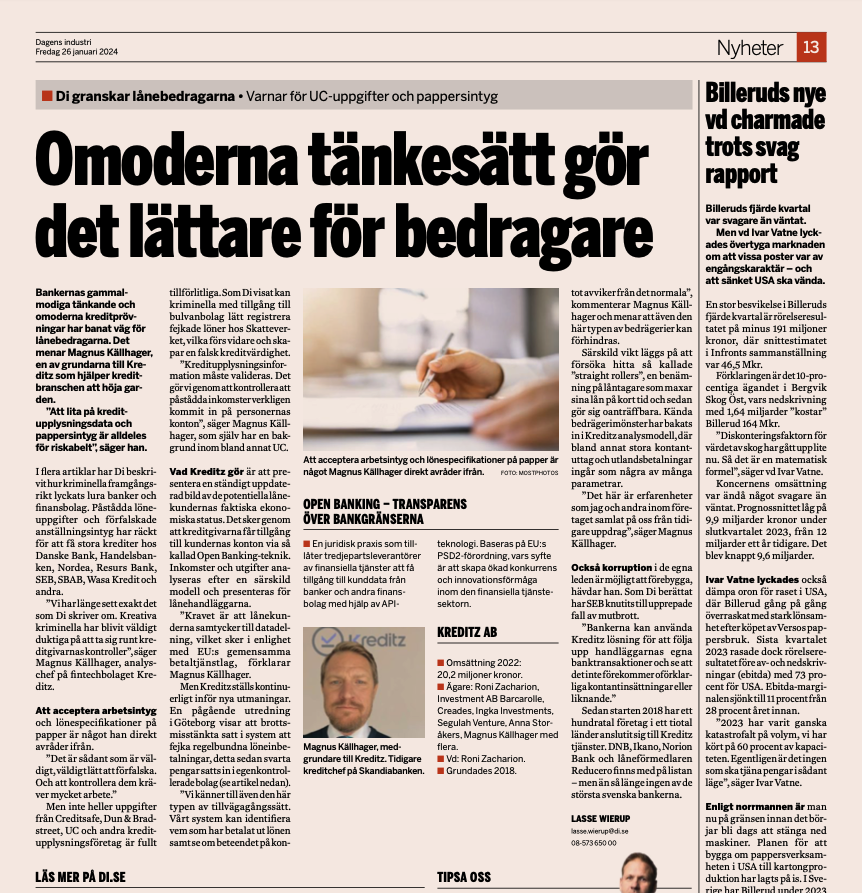
Organised criminals are exploiting outdated credit and verification processes in Sweden to launder money and secure loans with fake financial profiles, warns Magnus Källhager, co-founder of fintech company Kreditz.
In a recent high-profile case, a criminal network is suspected of using dozens of companies to funnel proceeds from drug trafficking and other serious crime. By routing cash through these firms, the group allegedly created fictitious salary payments and tax records, giving individuals a seemingly solid, “clean” financial history. On paper, they looked like stable, creditworthy borrowers – and were able to obtain mortgages and other loans, effectively turning illicit funds into legitimate assets.
According to Källhager, the core problem is that many lenders still rely heavily on traditional credit bureau data and manual documents such as payslips and employment certificates.
“Trusting credit bureau information and paper documents is far too risky,” he says. “Both are relatively easy to falsify and often expensive and slow to verify.”
He notes that even credit bureau records can be manipulated when criminals use front companies to register fabricated income over time, “manufacturing” a positive credit profile that passes standard checks.
Källhager argues that the industry needs to move from static, historical data to real-time verification based on actual account behaviour. Kreditz uses Open Banking – with the customer’s explicit consent under PSD2 – to retrieve transaction data directly from applicants’ bank accounts and build an always-updated view of their true financial situation.
This allows lenders to see who actually paid a salary, how money moves across accounts, and whether there are warning signs such as sudden spikes in borrowing, large cash withdrawals or frequent foreign transfers. Kreditz’s models are also designed to detect so-called “straight rollers” – borrowers who rapidly max out credit lines before disappearing.
The same approach can help banks strengthen internal controls, Källhager adds, by flagging unexplained cash deposits or unusual patterns in employees’ own accounts.
Since its launch in 2018, Kreditz has onboarded around 100 clients in roughly ten countries, providing real-time credit and risk intelligence across multiple markets. Yet, Källhager points out, Sweden’s largest banks have not yet fully embraced this kind of real-time, transaction-based verification – leaving a gap that sophisticated criminals are quick to exploit.
Stay up to date
Sign up to be the first to know about product launches, promotions and more.