
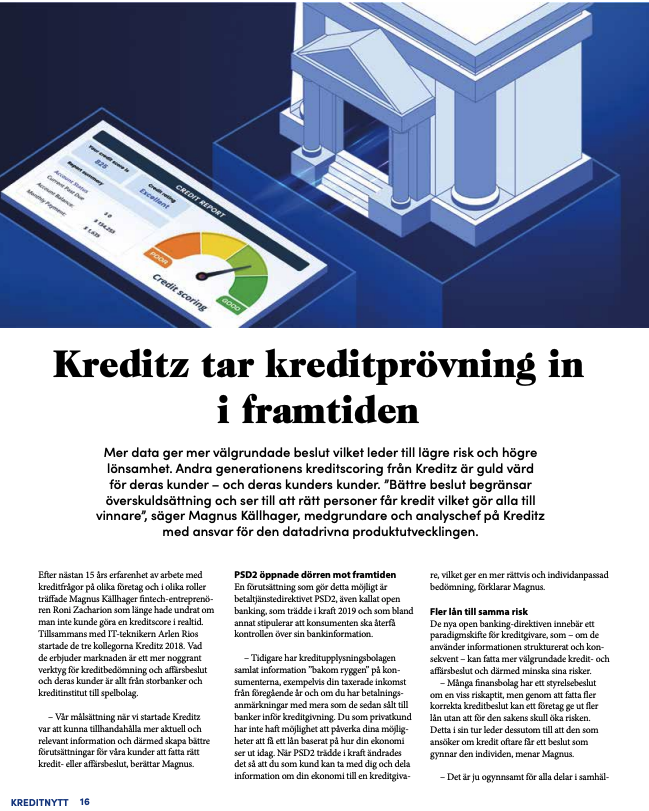
Kreditz takes credit assessment into the future
More data leads to better-grounded decisions, which in turn reduces risk and increases profitability. Kreditz’s second-generation credit scoring is gold for our clients and for their customers. “Better decisions limit over-indebtedness and make sure the right people get credit. That makes everyone a winner,” says Magnus Källhager, co-founder and Head of Analytics at Kreditz, responsible for our data-driven product development.
After almost 15 years working with credit issues in different companies and roles, Magnus met fintech entrepreneur Roni Zacharion, who had long been asking the same question: why can’t credit decisions be made in real time? Together with IT specialist Arlen Rios, they founded Kreditz in 2018. Today, Kreditz offers the market a more accurate tool for credit and business decisioning, with clients ranging from major banks and credit institutions to gaming companies.
“Our goal from day one was to provide more current and relevant information, and to create better conditions for our customers to make the right credit and business decisions,” Magnus says.
PSD2 opened the door to the future
A key enabler is the payment services directive PSD2, also known as Open Banking, which came into force in 2019. Among other things, PSD2 gives consumers the right to access and share their own banking information.
“Previously, credit bureaus collected information about consumers ‘behind their backs’ like last year’s taxable income or notes on payment remarks, and then sold that information to lenders. As a private individual you had little influence over how your financial situation was portrayed. With PSD2, that changed. Now you, as a customer, can bring and share your own up-to-date financial data directly with a lender,” Magnus explains. That creates a more fair and individualized assessment.
More loans with the same risk
The new Open Banking directive represents a real shift for lenders. When information is structured and interpreted correctly, it enables more accurate credit and risk decisions and therefore lower risk.
“Many financial companies set a policy limit for how much risk they can take from lending. But if you make more correct credit decisions, you can approve more loans without increasing the overall risk. That benefits both the company and the applicant,” Magnus says.
Over-indebtedness is harmful for everyone in society. Better underwriting based on real financial behavior helps prevent that.
Kreditz ACE – interpretation that increases accuracy
In traditional processes, banks often spend significant time trying to build systems to interpret and categorize transaction data. Instead, they can use Kreditz’s advanced interpretation engine, Kreditz ACE, which can interpret and categorize transaction data with high precision.
“As PSD3 comes into play, even more data will become available, and our tools will be applicable to even more customer processes,” Magnus adds.
Lending in practice with PSD2 data
How can PSD2 data be used in lending? To enable effective underwriting, interpreted PSD2 data is applied in several steps. The most common are credit scoring, policy rules, KALP (the standard affordability calculation), and income verification. Sometimes it also includes simple add-ons such as retrieving a bank account number automatically, which can speed up and reduce friction.
With PSD2-based scoring, lenders can calculate a much better probability of whether a customer is likely to repay their credit. This makes it possible to lend to customers who would previously have been declined, while filtering out borrowers who are less likely to manage the repayment.
Policy rules help ensure that no one slips through the process in conflict with internal guidelines for example if the applicant lacks stable income, has too many enforcement payments, or shows gambling-related risk behavior.
“KALP is a calculation of disposable income over time. Traditionally this has been done with standardized templates that aren’t always adapted to the individual. With real transaction data we can see the customer’s actual income and real costs. We can clearly see whether the budget is realistic. Today, too many decisions still ignore real living costs, which can lead to credit being granted to people who can’t afford it,” Magnus says.
Real-time credit assessment
With more available and interpretable information, PSD2 means the data used for credit decisions is far more current than in traditional underwriting.
“It speaks for itself, it’s much harder to make the right decision based on data that’s 18 months old, compared to data that shows how a customer has managed repayments month by month, or just made a new loan-related purchase a week ago,” Magnus says. “It shouldn’t matter who you are, where you come from, or which country you live in. As long as you can show that you’ve managed your finances well, you should be able to access credit,” Magnus says.
Because Kreditz works with the same type of information in every country, the company is building a global product that can work across many markets. Today Kreditz operates in two major regions, the Nordics and the UK, Germany, the Netherlands, Belgium and more, and is growing in markets such as Spain, France, and across the rest of Europe.
Stay up to date
Sign up to be the first to know about product launches, promotions and more.