
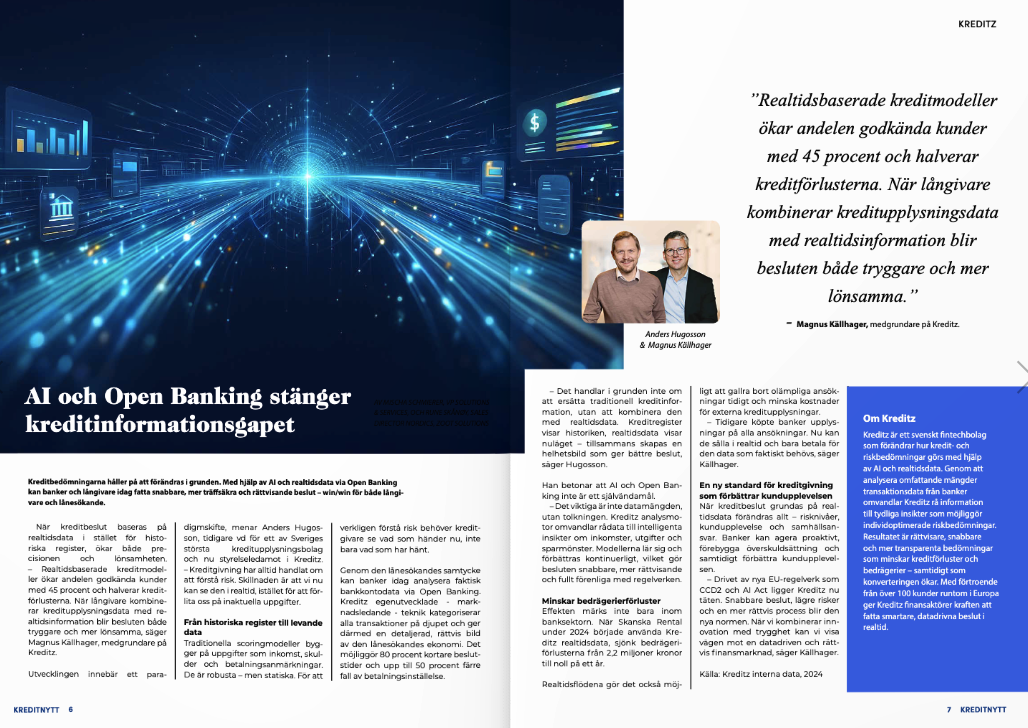
AI and Open Banking close the credit information gap
Credit assessments are changing at a fundamental level. With AI and Open Banking, banks and lenders can today make faster, more precise, and fairer decisions in real time.
When credit decisions are based on real-time data instead of historical registers, both precision and profitability improve.
“Real-time credit models increase approval rates by 45 percent and cut credit losses in half. When lenders combine traditional credit bureau information with real-time insight, decisions become both safer and more profitable,” says Magnus Källhager, co-founder of Kreditz.
This development represents a real paradigm shift, says Anders Hugosson, former CEO of a Swedish credit bureau and now a board member at Kreditz. “Lending has always been about understanding risk. The difference now is that we can see it in real time.”
From historical registers to living data
Traditional scoring models are built on variables such as income, debt levels, and payment remarks. They are robust but static. To truly understand risk, lenders need to see what is happening now, not only what happened in the past.
With customer consent, banks can analyze actual account data through Open Banking. Kreditz’s technology categorizes up to 97 percent of all transactions, providing a detailed and fair view of a customer’s finances. This enables decision times that are 80 percent faster and up to 50 percent fewer cases of payment suspension.
“It’s not about replacing traditional credit information, but combining it with real-time data. Credit registers show history, real-time data shows the present and together they create a full picture that leads to better decisions,” Hugosson says.
He stresses that AI and open data are not goals in themselves.
“What matters isn’t the volume of data, but how it’s interpreted. Kreditz’s analytics engine turns raw data into intelligent insights on income, expenses, and saving patterns. The models learn and improve continuously, making decisions faster, more accurate, and fully aligned with regulations.”
Preventing risk in real time
The impact isn’t limited to banking. When Skanska Rental began using real-time data through Kreditz in 2024, fraud losses dropped from SEK 2.2 million to zero within a year.
Real-time flows also allow lenders to filter out unsuitable applications early and reduce costs for external credit checks.
“Banks used to buy credit bureau reports for every application. Now they can screen in real time and only pay for the data that’s actually needed,” Källhager says.
A new standard for lending
When credit decisions are grounded in real-time data, everything changes such as risk levels, customer experience, and societal responsibility. Banks can act proactively, prevent over-indebtedness, and improve the customer journey at the same time.
“Driven by new EU regulations like CCD2 and the AI Act, Swedish players are now taking the lead. Faster decisions, lower risk, and a fairer process become the new norm. When we combine innovation with trust, we can help shape the path toward a data-driven and fair financial market,” Källhager concludes.
Source: Kreditz internal data, 2024.
Stay up to date
Sign up to be the first to know about product launches, promotions and more.